
A note on genetic provenance: This guide discusses the documented history and original breeder attribution of the named cultivar. Sigma Seeds supplies line-worked representations sourced through established European and North American breeding partners, not original-breeder packs unless explicitly stated. Stabilisation improves consistency but does not eliminate natural phenotype variation.
Lemon Cherry Gelato strain guide: the Sunset Sherbet × Girl Scout Cookies cross that became one of the most recognisable names in the modern exotic catalogue and one of the most disputed origins in recent cannabis history. The terpene profile is real and it’s exceptional: lemon zest, ripe cherry, creamy vanilla gas, and a caryophyllene backbone that gives the sweetness structure. The origin story is more complicated. Backpackboyz made LCG famous through a Cookies dispensary in Los Angeles in late 2019. The evidence suggests they didn’t breed it. What that means for the genetics, the phenotype, and what you’re running is covered honestly in this guide.
LCG’s cherry sits in a lemon-cream Cookies profile; by comparison, the Super Boof strain guide traces a darker cherry and orange-citrus profile over gas.
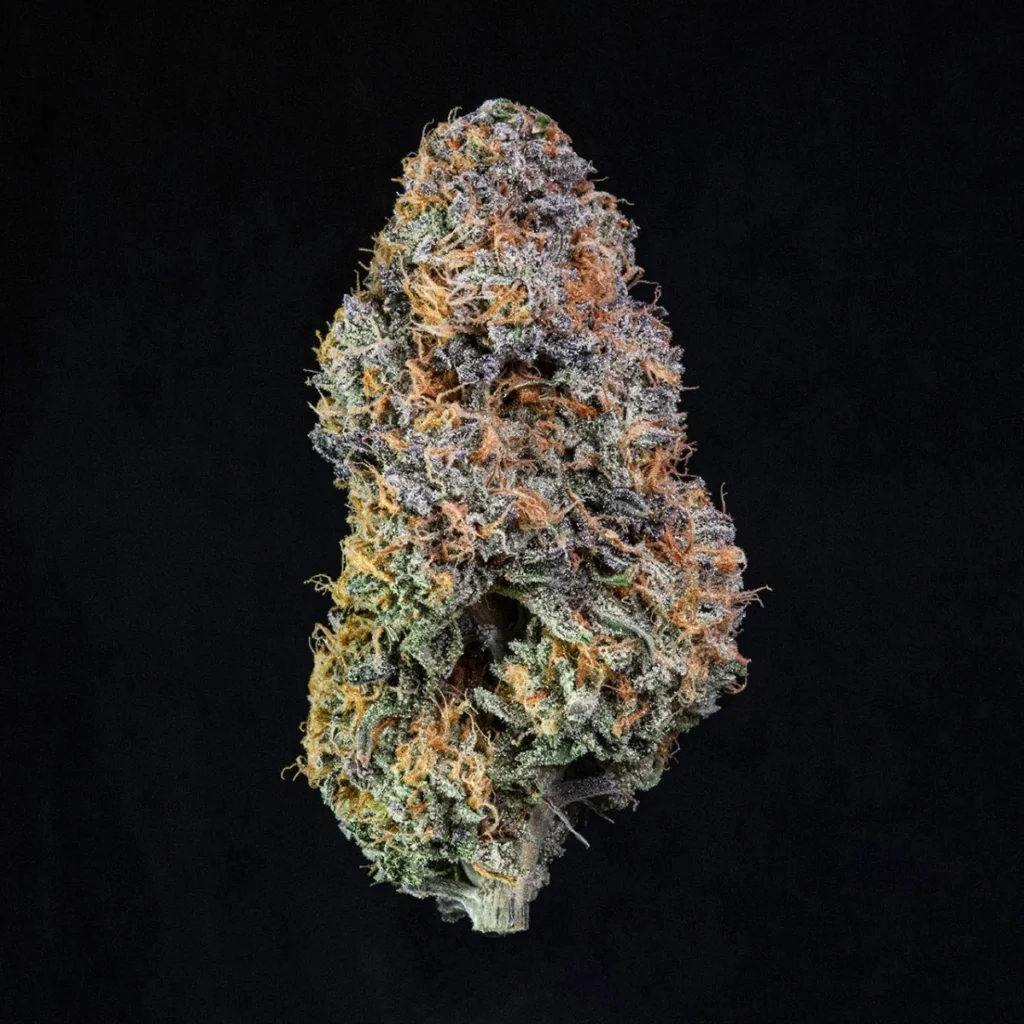
This is a deep-dive into Lemon Cherry Gelato: the disputed origin and what the evidence actually shows, what Sunset Sherbet and Girl Scout Cookies each contribute to the cross, the terpene chemistry, phenotype variation, keeper criteria, and what growing LCG in Australia requires. Lemon Cherry Gelato feminised seeds and Lemon Cherry Gelato autoflower seeds are both available in the Sigma catalogue. For the broader Cookies family context, the Cookies cannabis lineage guide traces how Sunset Sherbet and Girl Scout Cookies became the foundation of the modern exotic market.
In this guide
- The origin: Backpackboyz, Cannatique, and what the evidence shows
- Lineage: Sunset Sherbet × Girl Scout Cookies explained
- Terpene profile: caryophyllene, limonene, myrcene
- Phenotype variation: what to expect across the pack
- What to hunt for: the keeper criteria
- Growing Lemon Cherry Gelato in Australia
- Extraction: solventless performance
- LCG in the Sigma catalogue
Lemon Cherry Gelato: At a Glance
| Popularised by | Backpackboyz (Los Angeles, 2019) · Barney’s Farm × Backpackboyz collab (seed release) |
| Original breeder | Disputed — evidence points to Cannatique (see origin section) |
| Cross | Sunset Sherbet × Girl Scout Cookies |
| Also known as | LCG · Lemon Cherry · Gelato 33 adjacent |
| Indica / Sativa | Indica dominant · 60% Indica / 40% Sativa |
| THC | 20–33% · breeder ceiling figure; finished flower typically tests lower |
| Terpenes | Caryophyllene · Limonene · Myrcene |
| Flavour | Lemon · Cherry · Creamy vanilla · Gas · Berry · Sweet citrus |
| Flowering time | 60–65 days (8–9 weeks) |
| Yield | High · up to 600g/m² indoors under optimal conditions |
| Height | 90–140cm · medium to tall |
| Difficulty | Moderate |
| Seeds | LCG feminised photoperiod · LCG autoflower — Sigma Seeds Australia |
The Origin: Backpackboyz, Cannatique, and What the Evidence Shows
The dominant narrative
The story that circulated after 2019 was straightforward: Backpackboyz, the Los Angeles cannabis brand led by Juan Quesada, developed Lemon Cherry Gelato and released it through a Cookies dispensary in LA in late 2019. The strain became an almost instant hit. It took 2nd Place in the Medical Category at the 2021 High Times Medical Cup in Michigan. By 2022 it was a staple on dispensary menus across the US and Canada. By 2025 it was among the top-selling products for multiple commercial brands in legal markets. The Backpackboyz name and the strain became synonymous, and most sources, including Leafly, attributed the genetics to Backpackboyz.
What the evidence actually shows
The attribution is disputed at its foundation. In an interview that circulated in 2024, Ray Bama stated explicitly that neither Juan Quesada nor Backpackboyz bred Lemon Cherry Gelato. The evidence points to Cannatique as the actual cultivator: LCG originated as a bagseed (a seed found in purchased cannabis) that Cannatique grew out, selected, and named. The Backpackboyz connection was distribution, not breeding. The rename from the original strain designation was made, according to this account, to avoid legal conflict with the registered owners of the Runtz trademark.
This is not unusual in California’s underground-to-legal-market transition era. The gap between who bred a strain and who made it famous is well-documented across the modern exotic catalogue. The same dynamic produced the RS11 attribution disputes and the GMO naming confusion. Backpackboyz built a genuine cultivation and distribution operation with high quality standards, and their version of LCG set the benchmark for the strain’s commercial expression. Whether Quesada’s team bred the genetics or selected and distributed Cannatique’s work, the cultivar that became the market reference for Lemon Cherry Gelato came through their operation.
On the LCG attribution question
Sigma’s position on disputed provenance is the same here as it is with RS11: we present what is documented, flag what is disputed, and don’t smooth inaccurate confidence into the copy. The original breeder of Lemon Cherry Gelato is not confirmed. The cross — Sunset Sherbet × Girl Scout Cookies — is consistent across all credible sources regardless of who made it. The terpene profile, the phenotypic characteristics, and the growing data are all well-documented from five-plus years of commercial cultivation. That’s what matters for running the pack.
The Barney’s Farm collab
The seed version of Lemon Cherry Gelato that reached the widest international distribution came through a collaboration between Barney’s Farm and Backpackboyz, the second release in their partnership. Barney’s Farm brought their seed production infrastructure; Backpackboyz brought the genetics and the brand. The resulting feminised seed line made LCG accessible to collectors globally who couldn’t access the Backpackboyz clone-only cut directly. The collab version carries the same Sunset Sherbet × Girl Scout Cookies cross with a third undisclosed element that Barney’s Farm have referenced but not identified publicly. The seeds in the Sigma catalogue are sourced from trusted breeders working with this genetic territory.
Lineage: Sunset Sherbet × Girl Scout Cookies Explained
Two Cookies-family giants
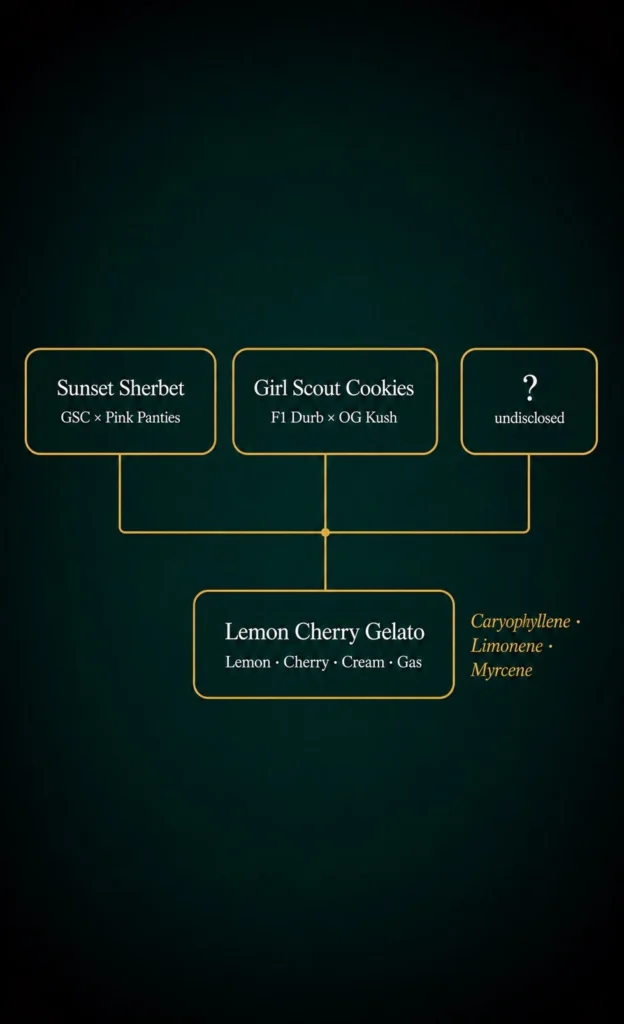
Lemon Cherry Gelato is a second-generation Cookies-family cross. Both parents trace to Girl Scout Cookies. Sunset Sherbet is GSC × Pink Panties. Girl Scout Cookies is the direct second parent. That means LCG has GSC on both sides of its lineage: a double Cookies concentration similar in structure to the double Sherbet concentration in Jealousy, though with different secondaries. The result is a strain that is deeply Cookies-family in character: the dense bud structure, the resin density, the dessert-sweet terpene direction, and the euphoric effect architecture all trace directly to that double GSC inheritance. For the full story of how GSC became Sunset Sherbet and what each generation contributed, the Cookies cannabis lineage guide covers the complete family tree.
What Sunset Sherbet contributes
Sunset Sherbet is the parent that gives LCG its creamy, fruity, berry-forward character. The Pink Panties male that accidentally pollinated a room of GSC at Sherbinski’s grow in 2012 contributed the Burmese Blackberry Kush’s berry and floral terpene expression. GSC contributed the sweet-dough base and the indica density. The result, Sunset Sherbet, was a strain with a creamy, sherbet-like profile that read as dessert in a way no cannabis had before it. In Lemon Cherry Gelato, Sunset Sherbet contributes the creamy vanilla and berry layer that sits underneath the lemon and cherry top notes. It’s the parent responsible for the round, smooth finish on the exhale and the body-forward physical effect that transitions from the initial cerebral euphoria.
What Girl Scout Cookies contributes
The direct GSC parent in LCG reinforces what Sunset Sherbet already carries from its own GSC heritage: dense bud structure, high resin production, sweet-dough terpene depth, and the euphoric uplift that defines Cookies-family effects. The double GSC concentration in LCG is what produces the exceptional trichome coverage and the dessert-candy terpene character that made the strain distinctive when Backpackboyz released it. GSC also contributes the genetic architecture that allows LCG to express the vivid purple, green, and orange colouration at harvest that became part of the strain’s visual identity.
Lemon Cherry Gelato Lineage: Traced Back
| Strain | Cross | What it contributes to LCG |
|---|---|---|
| Sunset Sherbet | Girl Scout Cookies × Pink Panties (accidental pollination, Sherbinski, 2012) | Creamy vanilla and berry terpene character. The smooth, rounded finish. Body-forward physical effect. Colour expression — purple and deep green hues. |
| Girl Scout Cookies | F1 Durb × Flo Rida OG Kush (Jigga, San Francisco, ~2007) | Dense bud structure, exceptional resin production, sweet-dough depth, euphoric Cookies-family effect architecture. Double GSC concentration alongside Sunset Sherbet’s own GSC heritage. |
| Pink Panties | Burmese Blackberry Kush × OG Kush (Jigga pollen on Sherbinski’s OG) | Berry and floral terpene contribution through Sunset Sherbet. The Burmese Blackberry Kush genetics that give LCG its cherry and dark berry top note. |
| Third element | Undisclosed (Barney’s Farm × Backpackboyz collab) | Not publicly identified. Likely contributing to the lemon citrus top note. The original bagseed origin makes this difficult to trace with certainty. |
Terpene Profile: Caryophyllene, Limonene, Myrcene
What LCG smells like
Open a well-cured jar of Lemon Cherry Gelato and the first thing that arrives is lemon: sharp, bright, and clean. Then the cherry note underneath, slightly sweet and slightly tart, like ripe dark cherry rather than the artificial maraschino quality that some fruit-forward genetics produce. The creamy vanilla gelato undertone sits below both: the Sunset Sherbet heritage expressing in the base note that rounds the profile and stops it reading as purely sharp-citrus. On the break, the cherry sharpens and a gas note arrives from the caryophyllene. The exhale carries the cream and berry character and lingers longer than most comparable profiles. It is the most distinctively named strain in the Sigma catalogue, and the name is accurate in a way that most cannabis marketing is not. It smells like lemon and cherry gelato.
Caryophyllene: structure under the sweetness
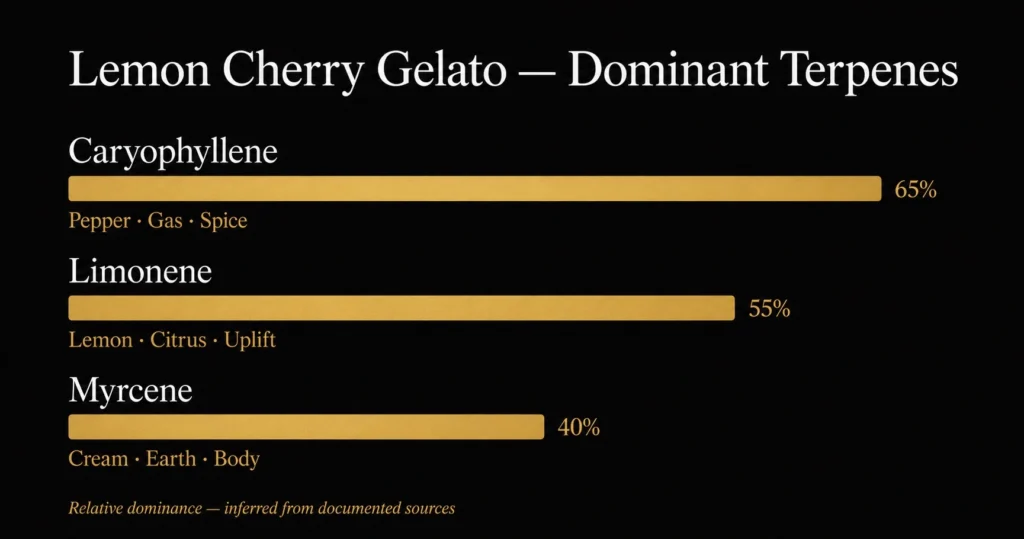
Caryophyllene is the dominant terpene in Lemon Cherry Gelato across all documented lab data and is the terpene most responsible for the strain’s effect architecture. It provides the peppery-spice backbone that prevents the profile from reading as purely dessert-sweet. In LCG, caryophyllene operates in the background rather than the foreground. You notice the lemon and cherry first, then the gas and spice arrive to anchor the experience. The pepper-fuel quality from the caryophyllene is what gives LCG its body-relaxing physical effect. Caryophyllene’s CB2 interaction contributes to the physical comfort that follows the initial cerebral euphoria. For the deeper terpene context, the Sigma terpene guide covers how terpene-cannabinoid interactions work.
Limonene: the citrus lead
Limonene drives the lemon top note: the bright, sharp citrus character that arrives first on jar open and defines LCG’s first impression. In this genetic context, limonene reads as sharp lemon-citrus rather than the tropical-guava direction it takes in Z-lineage genetics or the candy-sweet citrus of Gelato #41. The Cookies-family genetic context (double GSC, Sunset Sherbet) keeps the limonene expression grounded and bright rather than candy-sweet. It’s also the terpene associated with the initial euphoric uplift: limonene-dominant profiles produce the cerebral energetic onset that LCG’s effect is known for before the caryophyllene body-relaxation builds underneath it.
Myrcene: the creamy foundation
Myrcene provides the earthy, slightly herbal base that softens the caryophyllene edge and contributes to the smooth, rounded quality on the exhale. In LCG’s terpene context, myrcene reads as cream: the gelato undertone that the name references and that both Sunset Sherbet and GSC contribute through their shared Cookies-family heritage. Myrcene is also the terpene most associated with the sedating, body-settling quality that develops as the LCG experience progresses. The transition from the limonene-driven euphoric onset to the myrcene-caryophyllene body relaxation is what makes LCG’s effect profile feel balanced: both elements are present, and neither eliminates the other.
Terpene Stack: Lemon Cherry Gelato
| Terpene | Role in profile | Aroma contribution | Source parent |
|---|---|---|---|
| Caryophyllene | Primary / backbone | Pepper, gas, spice. Anchors the sweet profile and gives it structure. Contributes to body-relaxing effect via CB2 interaction. | GSC / Sunset Sherbet |
| Limonene | Secondary / citrus lead | Sharp lemon-citrus top note. First impression on jar open. Drives the euphoric onset. Bright and clean rather than candy-sweet. | GSC / undisclosed third element |
| Myrcene | Foundation / cream | Earthy, creamy, slightly herbal. The gelato undertone. Smooths the profile and contributes to the body-settling quality as effects develop. | Sunset Sherbet / GSC |
The research underpinning terpene-cannabinoid interactions and why individual terpene percentages don’t tell the full story is in Russo’s 2011 paper Taming THC: potential cannabis synergy and phytocannabinoid-terpenoid entourage effects in the British Journal of Pharmacology.
Phenotype Variation: What to Expect Across the Pack
Two primary directions
LCG produces phenotype variation along the Sunset Sherbet and GSC parent lines. Phenotypes leaning toward the Sunset Sherbet parent express more creamy-berry character: the cherry note is more prominent, the profile reads as sherbet-adjacent, and the colour expression at harvest is more vivid: deeper purples, more contrast between the green and purple bud tissue. Phenotypes leaning toward the GSC parent are denser, with a more pronounced sweet-dough foundation, a slightly more OG-adjacent gas note from the Cookies-family caryophyllene, and tighter bud structure.
Sherbet-leaning phenotypes are the most visually striking expressions in the pack. The purple and deep green colouration is most pronounced here. The cherry-berry terpene note leads, with lemon citrus secondary and the creamy vanilla in the base. These phenotypes are the ones closest to the visual identity that made LCG famous through the Backpackboyz releases: the “kaleidoscope of colours” bud structure with vivid purple, orange, and green that photographs exceptionally well and commands attention at harvest.
GSC-leaning phenotypes are denser and more compact, with a profile that leads with the sweet-dough GSC base before the cherry-lemon arrives. Trichome coverage is typically highest in this direction, and these phenotypes tend toward the stronger extraction performance: the high bract-to-leaf ratio from the OG Kush architecture in the GSC heritage produces more resin mass per gram of input material. Less visually dramatic than the Sherbet-leaning phenotypes, but often the stronger solventless candidate.
Visual characteristics
LCG at its best is one of the most visually striking strains in the modern catalogue. The combination of vivid purple hues from the Sunset Sherbet heritage, the deep green bud tissue, and the dense white trichome coverage produces the appearance that made it a dispensary shelf standout. Orange pistils contrast against the purple-green bud tissue. The buds are dense and relatively compact for an indica-dominant Cookies-family cross. Heavy, sticky trichome coverage from the double GSC resin architecture makes the buds tacky at harvest.
On LCG’s bag appeal
Part of what made Lemon Cherry Gelato famous so quickly was bag appeal. The purple-green-orange colouration photographed well on Instagram, which was the primary distribution channel for California’s premium genetics market in 2019. The Backpackboyz cultivated this deliberately — their presentation quality was unusually high for the era, and LCG’s visual profile suited their brand aesthetic. This is worth understanding because phenotype selection in this pack has a visual dimension as well as a terpene and effect dimension. The most photographically striking phenotype and the most terpene-expressive phenotype may not be the same plant. Evaluate on nose and effect first, visual appeal second.
What to Hunt For: The Keeper Criteria
Keeper criteria in priority order
Sigma Secrets: What to hunt for in a Lemon Cherry Gelato pack
The keeper is the plant where the name is accurate. Lemon and cherry, both present, neither dominant to the point of flattening the other, with the creamy vanilla gelato undertone holding them together. If one note overwhelms and the other disappears, you’re not looking at the keeper.
1. Both lemon and cherry are present in the profile at week 6 of cure. This is the defining criterion. Some phenotypes from this cross lead entirely with cherry and the lemon disappears. Others lead with citrus-lemon and the cherry is absent. The keeper holds both simultaneously. The name isn’t marketing: it’s the phenotype description. Evaluate the fresh break at four, six, and eight weeks — the integration of lemon and cherry improves through the cure as heavier compounds stabilise.
2. Creamy vanilla undertone in the base. The gelato quality — the Sunset Sherbet and GSC Cookies-family inheritance — should be detectable as a rounded, creamy sweetness that sits underneath the lemon-cherry top notes. If the profile reads as sharp citrus-only without the creamy base, the Sherbet heritage isn’t expressing. The creamy note becomes more apparent through an extended cure.
3. Gas arrives on the break, not on the jar open. The caryophyllene gas note should be present but secondary — arriving when the bud is broken rather than leading on the jar open. Phenotypes where gas dominates and the lemon-cherry character is suppressed are leaning too far toward the GSC caryophyllene backbone. The keeper has the gas as foundation, not foreground.
4. Purple expression at harvest. Not a terpene criterion — a genetic expression indicator. The Sunset Sherbet’s colour genetics should express in cool conditions. Deep purple bud tissue alongside the green, contrasting with orange pistils, is the visual signature of a Sherbet-leaning phenotype with full genetic expression. Run temperatures at 18°C lights-off in the final two weeks to encourage anthocyanin expression.
5. Effect onset is euphoric before it is physical. The limonene-driven cerebral uplift should be the first noticeable effect: an uplifted, sociable, slightly energetic quality that arrives within the first five minutes. The caryophyllene-myrcene body relaxation builds underneath it and eventually takes over. A phenotype that arrives heavy and sedating without the initial euphoric lift is expressing more myrcene-indica than limonene-euphoric character. The keeper has both, in that order.
For the full phenohunting framework on running a pack systematically from seed to keeper, the Sigma phenohunting guide covers the process in detail.
Growing Lemon Cherry Gelato in Australia
What the lineage predicts
LCG is rated moderate difficulty: accessible to growers who have completed at least one successful grow but not demanding the same environmental precision as MAC 1 or the careful timing that GMO requires. The double Cookies-family heritage produces a plant that is relatively forgiving by modern exotic standards. Height ranges from 90–140cm indoors, reflecting the Sunset Sherbet’s modest sativa stretch from the Durban Poison side of the GSC lineage. Flowering time of 60–65 days is on the shorter end for Cookies-family genetics.
Training and canopy management
LCG responds well to training. Low-stress training and topping in veg produce a flat, lateral canopy that develops the bud sites evenly and prevents the main cola from dominating to the exclusion of lateral development. The moderate height range means indoor growers have reasonable flexibility. Screen of Green (SCROG) is well-suited to this genetics. The lateral branching that develops under a screen produces the yield numbers that the “up to 600g/m² indoors” figure requires. Without training, expect lower yield from a less-developed canopy.
Colour expression
The purple colouration that defines LCG’s visual identity requires temperature differential in the final two weeks of flower. Dropping lights-off temperatures to 16–18°C triggers anthocyanin production in phenotypes carrying the Sunset Sherbet colour genetics. Without the temperature drop, the buds will still develop good structure and trichome coverage but may not express the deep purple colouration. This is an aesthetic choice rather than a quality requirement: the terpene profile and effect aren’t affected by whether the colour expresses.
Sigma Secrets: Australian growing notes
Indoor and outdoor both viable. Unlike MAC 1 or GMO, LCG is well suited to both indoor and outdoor cultivation in Australia. The moderate difficulty rating and the double Cookies-family genetic stability make it more forgiving of environmental variation than most modern exotics. Outdoor in temperate to warm Australian climates, spring planting (September–October) targets harvest in late March to early April, within the 60–65 day flowering window.
Humidity and flower density. LCG’s dense Cookies-family flowers can retain moisture late in the season. In Northern NSW, southeast Queensland and other humid coastal areas, maintain an open mid-canopy, strong circulation and close inspection after rain or prolonged high humidity. Protected outdoor cultivation is safer than an exposed site when wet weather is forecast near maturity. Drier inland and southern climates reduce this pressure but do not remove the need for airflow.
Colour expression outdoors. Australian autumn nights in March–April provide the temperature differential that triggers purple expression without any grower intervention in most temperate regions. Southern states (Victoria, Tasmania, ACT, southern NSW) will see the most consistent colour expression from natural temperature cycles. Northern states may not get sufficient overnight temperature drop for full colour development.
Autoflower notes. The LCG autoflower in the Sigma catalogue brings the same Sunset Sherbet × GSC genetic territory into an autoflowering format: useful for growers wanting multiple annual harvests outdoors or year-round indoor production without light cycle management. Expect a slightly more compact structure and a profile that is consistent with the photoperiod version, with phenotype variation reduced by the autoflower breeding process. For a full run across the pack, the photoperiod version gives you more variation to select from.
Extraction: Solventless Performance
Why LCG performs well for solventless
The double GSC genetics in Lemon Cherry Gelato produce the trichome architecture that solventless extraction requires: dense, heavy resin coverage with a high bract-to-leaf ratio that translates to strong wash yields. The Cookies-family OG Kush heritage through GSC’s lineage contributes the capitate-stalked trichome structure that washes cleanly in ice water extraction. LCG’s high documented yield (up to 600g/m²) reflects real resin production, not just bud mass: this is an extraction-grade genetics by design.
The terpene profile carries through extraction well. The caryophyllene backbone is heat-stable and persists through rosin pressing at standard temperatures. The limonene citrus fraction is more volatile and benefits from lower press temperatures or fresh frozen processing. A fresh frozen live rosin from a well-grown LCG keeper should carry the lemon-cherry character clearly alongside the creamy vanilla base: one of the most distinctively flavoured solventless profiles available in the Sigma catalogue.
Sigma Secrets: Extraction notes
Fresh frozen preferred. The limonene fraction that drives LCG’s citrus top note is volatile and degrades faster than caryophyllene under heat and during drying and curing. Fresh frozen processing preserves the lemon-cherry character significantly better than dry-cured material. The profile in live rosin from a fresh frozen LCG run should be noticeably brighter and more citrus-forward than dry-cured rosin from the same plant.
Ice water hash. Run at 1–4°C with standard agitation. The double Cookies-family trichome architecture washes well. First wash is the most terpene-rich. Use 73–90 micron collection bags for the highest quality fraction.
Rosin press temperature. Keep at 65–75°C for live rosin to preserve the limonene citrus fraction. The caryophyllene backbone will carry through at higher temperatures, but the lemon-cherry character that defines the profile will flatten above 80°C. The goal is a rosin that carries the lemon-cherry-cream profile from the flower — lower press temperature is the variable most responsible for achieving it.
LCG in the Sigma Catalogue
Where LCG sits relative to other Cookies-family strains
The Sigma catalogue has five Cookies-family strains. Jealousy is the double Sherbet concentration — cream and candy taken to its logical extreme. Permanent Marker is the three-generation Cookies inheritance with a soapy-marker-gas character unlike anything else in the range. MAC 1 and Cap Junky go through Alien Cookies into fuel and incense territory. GMO takes the Forum Cut GSC into savoury-garlic-diesel. Lemon Cherry Gelato is the most accessible of the group: the clearest, most literal terpene expression, the most moderate growing difficulty, and the one that requires the least prior experience with exotic genetics to appreciate. It’s the entry point into the Cookies-family catalogue for growers who haven’t run Cookies-lineage genetics before, and it rewards experienced growers with a phenohunting run that finds a distinctively expressive keeper.
Lemon Cherry Gelato in the modern catalogue
Lemon Cherry Gelato became famous fast — faster than almost any other strain in recent cannabis history — because it did something the market was ready for: it combined two of the most trusted genetics in the Cookies family into a profile that was legible, visually stunning, and the profile is distinctively flavoured. The disputed origin doesn’t change what the genetics produce. The Sunset Sherbet and Girl Scout Cookies cross is consistent across all credible sources, and the terpene expression is documented across five years of commercial cultivation. LCG feminised photoperiod and LCG autoflower are both available in the Sigma catalogue. Browse the full Sigma catalogue to see how LCG sits alongside the rest of the Cookies-family range.
Frequently Asked Questions: Lemon Cherry Gelato Strain
What is Lemon Cherry Gelato?
Lemon Cherry Gelato is an indica-dominant hybrid (60/40) developed from a Sunset Sherbet × Girl Scout Cookies cross. It became one of the most widely recognised strains in the modern exotic catalogue after Backpackboyz released it through a Cookies dispensary in Los Angeles in late 2019. THC documented at 20–33% depending on the source and cultivation conditions. Dominant terpenes: caryophyllene, limonene, myrcene.
Who bred Lemon Cherry Gelato?
Disputed. The dominant attribution is Backpackboyz (Juan Quesada, Los Angeles). Evidence from a 2024 interview with Ray Bama indicates that neither Quesada nor Backpackboyz bred the original genetics — the strain originated as a bagseed cultivated by Cannatique. Backpackboyz popularised and distributed it. The original breeder is not confirmed. The cross (Sunset Sherbet × Girl Scout Cookies) is consistent across all credible sources regardless of attribution.
What does Lemon Cherry Gelato smell and taste like?
Lemon zest and ripe cherry upfront, with a creamy vanilla gelato undertone in the base and a caryophyllene gas-spice note on the break and exhale. The name is accurate: it smells like lemon and cherry gelato. The creamy base note becomes more apparent through an extended cure. The exhale carries the lemon-cherry character with a gas and pepper quality that lingers.
What are Lemon Cherry Gelato’s genetics?
Sunset Sherbet × Girl Scout Cookies, with an undisclosed third element referenced by Barney’s Farm in their collab version. Sunset Sherbet is a GSC × Pink Panties cross (Sherbinski, 2012). Girl Scout Cookies is a Durban Poison × OG Kush cross (Jigga, San Francisco, ~2007). LCG has GSC on both sides of its lineage: a double Cookies-family concentration that produces the resin density, bud structure, and dessert terpene character the strain is known for.
How long does Lemon Cherry Gelato take to flower?
60–65 days (8–9 weeks). On the shorter end for modern Cookies-family genetics. The flowering window is well-documented across commercial cultivation runs. Do not harvest early: the full terpene integration of lemon, cherry, and creamy vanilla develops in the final week of the flowering window and continues through the cure.
Is Lemon Cherry Gelato good for solventless extraction?
Yes. The double Cookies-family trichome architecture produces heavy resin coverage with a high bract-to-leaf ratio that washes well in ice water extraction. Fresh frozen processing is preferred to preserve the limonene citrus fraction. Rosin press at 65–75°C for live rosin to carry the lemon-cherry character through. The profile in well-processed LCG rosin is among the most distinctively flavoured in the catalogue.
What is the difference between LCG photoperiod and LCG autoflower?
The photoperiod version requires a light cycle change to trigger flowering and gives you more phenotype variation to select from across a pack. The autoflower version flowers automatically regardless of light schedule, is more compact, and suits outdoor growers wanting multiple harvests per year or indoor growers who don’t want to manage light cycles. The terpene profile is consistent between the two formats — the autoflower genetic crossing process does not fundamentally change what Sunset Sherbet × GSC produces, though individual plant variation is reduced.
How does LCG compare to Jealousy?
Both are Cookies-family dessert genetics with double GSC heritage, but they go in different directions. Jealousy (Gelato #41 × Sherb BX1) is a double Sherbet concentration — cream-and-candy taken to its extreme, with a profile that reads as amplified Gelato. LCG leads with lemon and cherry specifically: brighter, more citrus-forward, with the creamy gelato quality as an undertone rather than the lead note. LCG is more approachable; Jealousy is more intensely Cookies-dessert. Both belong in a Cookies-family collection and they complement each other rather than duplicate.
