
A note on genetic provenance: This guide discusses the documented history and original breeder attribution of the named cultivar. Sigma Seeds supplies line-worked representations sourced through established European and North American breeding partners, not original-breeder packs unless explicitly stated. Stabilisation improves consistency but does not eliminate natural phenotype variation.
Jealousy strain guide: Gelato #41 × Sherb BX1, Leafly’s 2022 Strain of the Year, and the most concentrated expression of the Cookies-Sherbet lineage in the modern catalogue. Berner, the Cookies co-founder who helped build the Gelato family, described it as smelling like “Gelato times 100.”
That’s not hyperbole. It’s the most accurate single-line description of what Jealousy does that anyone has produced. Understanding why requires understanding the genetics, specifically the double Sherbet concentration that defines this strain and distinguishes it from every other Gelato derivative in the market.
This is a deep-dive into the Jealousy strain for collectors who want more than a flavour note and a THC percentage: lineage, the Seed Junky breeding philosophy, the terpene chemistry, phenotype variation, keeper criteria, and what the Jealousy genetics mean for the modern catalogue, including the strains it produced. If you’re new to reading exotic genetics and terpene profiles, the exotic strains guide and the terpene guide cover the foundations.
In this guide
- Seed Junky Genetics and JBeezy — the breeder behind the strain
- Lineage — Gelato #41 × Sherb BX1 and the double Sherbet stack
- The Gelato times 100 profile — what the quote means chemically
- Terpene profile — caryophyllene, limonene, myrcene, linalool
- Phenotype variation — what to expect across the pack
- What to hunt for — the keeper criteria
- Growing Jealousy — what the lineage predicts
- Extraction — solventless potential
- Jealousy’s downstream impact — the strains it made possible
Jealousy — At a Glance
| Breeder | Seed Junky Genetics (JBeezy / Anthony Hart) |
| Cross | Gelato #41 × Sherb BX1 |
| Indica / Sativa | 50% Indica · 50% Sativa |
| THC | 24–30% · CBD <1% |
| Terpenes | Caryophyllene · Limonene · Myrcene · Linalool (selected phenotypes) |
| Flavour | Creamy gelato · Sweet candy · Gas · Pepper · Citrus · Berries |
| Flowering time | 8–9 weeks |
| Yield | High · 450–550g/m² indoors |
| Height | Medium · compact and manageable |
| Difficulty | Moderate |
| Awards | Leafly Strain of the Year 2022 · 2nd overall California High Times Cannabis Cup 2022 |
| Seeds | Jealousy feminised photoperiod — Sigma Seeds Australia |
Seed Junky Genetics and JBee
 zy — The Breeder Behind the Strain
From garage to Northridge
Seed Junky Genetics was founded by Anthony Hart, known throughout the cannabis industry as JBeezy, out of a small garage operation in Southern California. The operation grew into a commercial facility in Northridge as the California legal market opened in 2016, but the breeding philosophy stayed consistent: phenotype stability first, terpene complexity second, commercial appeal as a consequence rather than a starting point.
JBeezy’s catalogue reads like a shortlist of the modern Cookies-family canon: Wedding Cake, Ice Cream Cake, Kush Mints, The Soap, Biscotti, and Jealousy among the most significant. Each reflects the same approach: take two well-understood parent lines, select rigorously for the phenotype that expresses the best combination of traits, and hold it to a testing standard tighter than the industry norm. Seed Junky’s self-imposed ±5% THC variance policy, tighter than the ±10% standard most commercial operations accept, is the practical expression of this philosophy. What the label says is closer to what you get, which matters when you’re selecting genetics for a serious run.
Jealousy’s place in the Seed Junky catalogue
Jealousy debuted in 2019, an early entry into what became the defining wave of Seed Junky genetics in the early 2020s. Initial releases were limited to select growers, with seeds available only as rare, premium-priced regular seeds rather than feminised ones. That scarcity built collector appetite before broad distribution was possible. By 2021, Seed Junky began licensing commercial clones to growers. In 2022, Cookies brand stores were selling Jealousy clones at $500 each, with consistent sellout. That year, Leafly named it Strain of the Year and it placed second overall at the California High Times Cannabis Cup. Cultural validation and commercial performance arrived together, confirming what the collector market had already concluded: Jealousy was the most refined expression of what Seed Junky had been building toward since Wedding Cake.
On Seed Junky’s testing standard
Seed Junky’s ±5% THC variance policy means a Jealousy pack listing 27% THC should test between 25.65% and 28.35% across phenotypes. Most commercial genetics operations operate with considerably more variance. The tighter standard is both a quality signal and a selection discipline: it requires genetics stable enough that most phenotypes in a pack perform within a narrow range. For collectors running Jealousy seeds, that means the pack is more predictable at the high end of performance than most genetics at similar price points.
Lineage — Gelato #41 × Sherb BX1 and the Double Sherbet Stack
Gelato #41 — the Cookies-Sherbet foundation
Gelato #41 is a Sunset Sherbet × Thin Mint Cookies cross, one of the most celebrated phenotypes from the Gelato line, developed by the Cookies family in California. Sunset Sherbet contributes the creamy, fruity dessert character. It is itself a Girl Scout Cookies × Pink Panties cross, making Gelato #41 a three-generation Cookies-family expression. Thin Mint Cookies adds the cool mint-herbal quality that distinguishes Gelato #41 from other Gelato phenotypes and contributes the aromatic sharpness that prevents the profile from being purely sweet. In Jealousy, Gelato #41 is the female parent, contributing the terpene complexity, the trichome density, and the sativa-leaning cerebral quality that defines the strain’s effect profile.
Sherb BX1 — the Animal Cookies backcross
Sherb BX1 is where Jealousy’s lineage gets more specific than most accounts acknowledge. It’s not simply a Sherbert OG backcross. It’s a cross of Sherbert OG with Animal Cookies, backcrossed to concentrate specific Sherbet traits while introducing the Animal Cookies indica density and caryophyllene-dominant gas character. Animal Cookies is a Girl Scout Cookies × Fire OG cross, which means Sherb BX1 carries OG Kush heritage through the Animal Cookies side in addition to the Sherbet genetics more commonly cited. That OG heritage is the origin of the caryophyllene dominance that makes Jealousy’s gas backbone more pronounced than you’d expect from a pure Gelato-Sherbet cross.
The double Sherbet concentration
The most significant structural feature of Jealousy’s genetics is the double Sherbet concentration. Gelato #41 has Sunset Sherbet in it. Sherb BX1 is a Sherbet backcross. Both parents carry Sherbet genetics, so Jealousy carries significantly more Sherbet influence than either parent alone would suggest. The cream-and-dessert character, the colour expression, the resin density: all are Sherbet characteristics, amplified in Jealousy because both parents contribute them simultaneously. This is exactly what Berner identified when he described the profile as “Gelato times 100” — not a Gelato clone, but a Gelato-family expression with the Sherbet concentration turned up to a level that Gelato #41 itself doesn’t achieve. By comparison, Lemon Cherry Gelato’s double-Cookies lineage concentrates GSC through Sunset Sherbet and a direct GSC parent rather than stacking Sherbet on both sides. The photoperiod Lemon Cherry Gelato seeds are the direct commercial expression of that comparison.
The full story of how GSC became Sunset Sherbet, then Gelato, then Jealousy is covered in the Cookies cannabis lineage guide.
Jealousy Lineage — Traced Back
| Strain | Cross | What it contributes to Jealousy |
|---|---|---|
| Gelato #41 | Sunset Sherbet × Thin Mint Cookies | Creamy dessert terpene base, trichome density, sativa-leaning cerebral effect, Cookies-family fruit and sweetness. |
| Sherb BX1 | Sherbert OG × Animal Cookies (backcross) | Caryophyllene-dominant gas backbone (from Animal Cookies OG heritage), indica density, colour expression, amplified Sherbet cream character. |
| Sunset Sherbet | Girl Scout Cookies × Pink Panties | Present in both parents — the double concentration that defines Jealousy. Cream, berry, and colour development. |
| Animal Cookies | Girl Scout Cookies × Fire OG | OG heritage into the Sherb BX1 parent — the source of Jealousy’s caryophyllene-dominant gas profile that distinguishes it from straight Gelato crosses. |
| Thin Mint Cookies | Girl Scout Cookies phenotype | Cool herbal-mint sharpness that prevents the profile reading as purely sweet. The note that distinguishes Gelato #41 from other Gelato phenotypes. |
The Gelato Times 100 Profile — What the Quote Means Chemically
Why Berner’s description is accurate
When Berner described Jealousy as smelling like “Gelato times 100,” he wasn’t reaching for a metaphor. He was describing a specific chemical reality: Jealousy’s Gelato-family terpene expression is more concentrated, more vivid, and more persistent than Gelato #41 itself produces. The double Sherbet concentration is the mechanism. Both parents contribute the same cream-and-dessert terpene direction, and the combined effect amplifies that character beyond what either parent achieves independently.
The practical result is a strain that reads as Cookies-family, the creamy sweetness is unmistakable, but at a concentration more intense than the Gelato baseline most collectors are familiar with. Caryophyllene’s gas and spice cuts through the sweetness and stops it tipping into saccharine. Limonene adds a citrus brightness that makes the profile feel alive. Total terpene content in Jealousy is frequently measured at 2.0–3.5% by weight in well-run indoor rooms, with craft batches exceeding 4.0%. That figure sits among the highest in the modern catalogue for a Cookies-family genetics.
The SOTY validation
The Leafly Strain of the Year award for 2022 was not a surprise to anyone who had run Jealousy. A distinctive and intensely concentrated Cookies-family profile, high THC output, and Seed Junky’s tight testing variance produced a genetics that performed reliably at a level the market could verify. Placing second overall at the 2022 California High Times Cannabis Cup alongside the SOTY win confirmed that Jealousy’s performance held under competitive scrutiny, not just collector enthusiasm. That dual validation in the same year is rare in the modern strain market.
On total terpene content
Total terpene content is the combined percentage of all terpene compounds measured in dried flower. Most commercial cannabis tests at 1.0–2.0% total terpenes. Jealousy lands at 2.0–3.5% in well-run indoor rooms, with select craft batches exceeding 4.0% at time of testing. This figure is worth asking for when evaluating any Jealousy-genetics product. It’s a more reliable indicator of the profile’s intensity and complexity than THC percentage alone. High total terpenes alongside high THC is the combination that produces the experience Jealousy is documented for.
Terpene Profile — Caryophyllene, Limonene, Myrcene, Linalool
Caryophyllene — the dominant and defining terpene
Caryophyllene is the primary terpene in Jealousy, a fact that surprises collectors who expect a Gelato-family genetics to lead with myrcene or limonene. The dominance comes from the Animal Cookies heritage in the Sherb BX1 parent, the OG-adjacent gas and spice backbone that distinguishes Jealousy from straight Gelato derivatives. Caryophyllene contributes pepper, fuel, and a pungent chemical spice that sits underneath the creamy sweetness, giving the profile its depth and complexity. Without it, Jealousy would be a straight dessert strain. With it, the profile has the gas-and-cream combination that makes it worth hunting.
Caryophyllene is also the terpene most associated with Jealousy’s effect profile. Its documented anti-inflammatory and mood-elevating properties contribute to the energising headspace that sets Jealousy apart from the more sedating Gelato phenotypes. The sativa-leaning cerebral onset from the Gelato #41 side, combined with the caryophyllene-driven mood elevation, produces an effect profile described as bright and dimensional rather than flat or heavy. For a detailed breakdown of caryophyllene and how it functions in the cannabis terpene matrix, see the Sigma terpene guide.
Limonene — candy brightness and citrus lift
Limonene is the secondary terpene, providing the candy sweetness and citrus brightness that sit above the caryophyllene base. In Jealousy, limonene comes primarily from the Gelato #41 parent through the Sunset Sherbet lineage. Its role is to lift and brighten the profile: the candy and citrus notes that arrive on jar open before the heavier terpenes come through. At these concentrations, limonene also contributes to the mood-elevating character of the effect profile, consistent with research on citrus terpene interactions with the endocannabinoid system.
Myrcene: the creamy base
Myrcene provides the creamy, earthy depth that anchors the profile. It’s the foundation that makes the caryophyllene and limonene combination read as complex rather than sharp. From both parent lines through the Sherbet genetics, myrcene contributes the berry and tropical fruit undertones that sit in the mid-register of the aroma. At these concentrations, myrcene also correlates with trichome density, consistent with Jealousy’s visually distinctive resin production.
Linalool and farnesene — the complexity markers
Linalool appears in selected Jealousy phenotypes, contributing the floral, soapy softness that prevents the caryophyllene from reading as purely sharp or chemical. Phenotypes with clear linalool expression have a smoother, more rounded profile where the gas and spice notes sit in a floral context rather than a raw chemical one. Farnesene, a sesquiterpene documented in Jealousy live resin analysis, adds a subtle herbal and woody depth in the phenotypes that carry it. Neither linalool nor farnesene appear in every plant in the pack, but both are worth identifying and prioritising during a hunt.
Terpene Stack — Jealousy
| Terpene | Role in profile | Aroma contribution | Source parent |
|---|---|---|---|
| Caryophyllene | Primary / gas backbone | Pepper, fuel, chemical spice. The note that gives Jealousy its depth and prevents it reading as purely sweet. | Sherb BX1 (Animal Cookies / OG heritage) |
| Limonene | Secondary / candy lift | Candy sweetness, citrus zest, brightness. First impression on jar open before the heavier terpenes emerge. | Gelato #41 (Sunset Sherbet lineage) |
| Myrcene | Foundation / creamy depth | Berry, tropical fruit undertones, cream. Anchors the profile and contributes to trichome density. | Both parents (Sherbet lineage) |
| Linalool | Floral softener (selected phenos) | Floral, soapy, lavender-adjacent. Smooths the caryophyllene edge in phenotypes where present. | Sherbet lineage |
| Farnesene | Depth note (selected phenos) | Herbal, woody, slightly floral. Documented in live resin analysis. Adds complexity in phenotypes that carry it. | Sherbet / Cookies lineage |
The research underpinning caryophyllene’s interaction with the endocannabinoid system — and why it contributes to Jealousy’s effect profile in ways that go beyond aroma — is covered in Russo’s 2011 paper Taming THC: potential cannabis synergy and phytocannabinoid-terpenoid entourage effects, published in the British Journal of Pharmacology.
Phenotype Variation — What to Expect Across the Pack
The two phenotype directions
Jealousy produces meaningful variation. Seed Junky’s tight testing variance doesn’t mean phenotypic uniformity, it means consistent potency and terpene output across diverse expressions. The variation tends to split along two directions: phenotypes leaning toward Gelato #41’s sativa-influenced, candy-bright expression, and phenotypes leaning toward Sherb BX1’s indica-dominant, gas-heavy, cream-dense expression.
Gelato-leaning phenotypes grow taller and more open-structured, with a profile that leads more clearly with the limonene candy-citrus brightness. The caryophyllene gas note is present but sits further behind the sweet top notes. These phenotypes tend toward a more energising, cerebral effect onset. Structure is more open, with slightly less compact bud formation than Sherb-leaning phenotypes.
Sherb-leaning phenotypes are where the caryophyllene dominance comes forward most clearly: the gas-and-cream combination that defines Jealousy at its most distinctive. These phenotypes produce the densest bud structure, the heaviest trichome coverage, and the most pronounced purple and dark green colour development under cool late-flower temperatures. The linalool and farnesene complexity markers are more likely to appear in Sherb-leaning phenotypes, where the floral-soapy softening of the caryophyllene backbone is most clearly present.
Colour expression
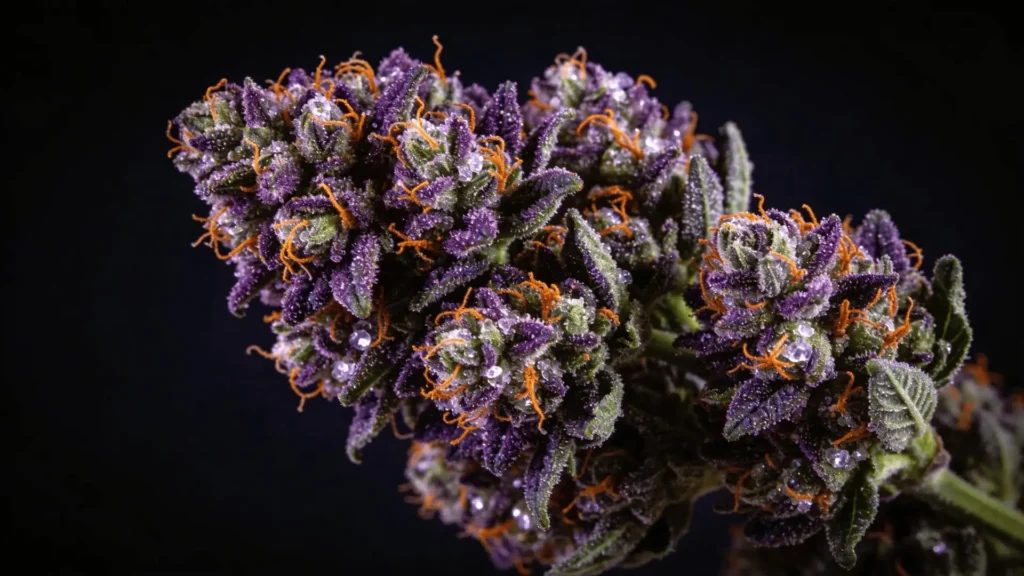
Jealousy is known for its visual distinctiveness: vibrant dark purple, green, orange, and yellow-hued buds, with the most dramatic colour expression appearing in phenotypes that carry the Sherb BX1 anthocyanin genetics. Dropping night temperatures to 17–18°C in the final two to three weeks of flower triggers this expression in susceptible phenotypes. Colour development without temperature management is a reliable indicator that a phenotype is carrying the genetics strongly. Colour is a valid selection criterion for visual quality but should never override terpene profile and nose-to-smoke translation as a keeper priority.
What makes Jealousy worth hunting
The Jealousy strain’s value as a phenohunt is in the intersection phenotypes — the expressions where the Gelato #41 candy brightness and the Sherb BX1 caryophyllene gas are both clearly present and neither is overwhelming the other. These phenotypes express exactly what Berner’s “Gelato times 100” description captures: a Cookies-family dessert profile at a concentration and complexity level that straight Gelato #41 doesn’t achieve. They’re not the most common expression in the pack, but they are the most valuable and the ones that justified the SOTY win. Understanding what you’re looking for before you start the hunt is what produces this result. For the full framework on running a pack systematically, see the Sigma phenohunting guide.
What to Hunt For — The Keeper Criteria
Keeper criteria in priority order
Sigma Secrets — What to hunt for in a Jealousy pack
1. Gas and cream are both present and balanced at week 6 of cure. The caryophyllene gas note and the Gelato cream-and-candy sweetness should coexist — neither overwhelming the other. A phenotype that reads as purely sweet is a Gelato-leaning expression that has lost the caryophyllene backbone. A phenotype that reads as purely gassy has lost the Gelato complexity. The keeper holds both simultaneously. Evaluate at six weeks of cure minimum — the caryophyllene-limonene balance continues to develop through the cure.
2. Terpene concentration is vivid on jar open. Jealousy should be immediately loud — the “Gelato times 100” intensity should be apparent before grinding. A phenotype where the profile is quiet or restrained in the jar, even if it improves on grinding, is not expressing the concentration that defines the strain. The keeper announces itself.
3. Nose-to-smoke translation. The gas-and-cream combination should carry from jar to exhale. Jealousy’s documented strength is a profile that translates clearly — the caryophyllene spice and the limonene candy sweetness should both be present in the smoke. Phenotypes with strong jar presence that disappear on the exhale are not keepers.
4. Linalool or farnesene complexity markers. If either is present — the floral-soapy note of linalool or the herbal-woody depth of farnesene — prioritise this phenotype. These complexity markers are not present in every plant in the pack, and their presence elevates the profile from excellent to exceptional.
5. Resin density and colour expression. Dense, uniform trichome coverage and natural colour development without forced temperature drops are supporting criteria. Prioritise these after terpene profile and nose-to-smoke are confirmed — they’re quality indicators, not primary selection drivers.
Growing Jealousy — What the Lineage Predicts
Structure and Cookies-family characteristics
Jealousy’s Cookies-family heritage predicts the key growing characteristics reliably. Dense, compact bud architecture with tight internodal spacing is a Gelato #41 characteristic amplified by the Sherb BX1 indica density. The medium height stays manageable without significant training. Cookies-family genetics prefer stable temperatures and consistent nutrition. They are sensitive to overfeeding, particularly nitrogen in late veg and early flower: tip burn is a consistent early indicator of excess. Thorough flushing in the final two weeks directly affects the clarity of the terpene profile on smoke, which matters more for Jealousy than for genetics where the terpene expression is less layered.
Flowering and harvest timing
Jealousy runs 8–9 weeks in flower, on the shorter end of the modern exotic catalogue. The terpene development and colour expression both continue through the final week. Harvesting at week eight on a phenotype ready to run to week nine will produce a flatter profile and less dramatic colour. Trichome maturity is the reliable harvest indicator: cloudy heads with developing amber, not calendar timing.
Sigma Secrets: Australian growing notes
Outdoor timing. Spring planting (September–October) generally points to a March–April harvest under natural Australian photoperiods, although latitude, phenotype and the onset of flowering can move completion earlier or later. The 8–9 week flowering window is relatively short once flowering is established, but growers in Queensland and Northern NSW should not assume it will finish before humid late-season weather. Dense phenotypes still require proactive airflow, canopy inspection and protection from prolonged rain through the final weeks.
Colour management. Drop night temperatures to 17–18°C in the final two to three weeks to bring out the purple and dark green colour expression in phenotypes carrying the anthocyanin genetics. Southern Australian climates often achieve this naturally in late summer nights. Queensland and Northern NSW growers may need to manage it actively for indoor grows.
Airflow. The dense Cookies-family bud structure creates moisture retention risk in the mid-canopy without adequate air circulation. This applies across all Cookies-family genetics, not just Jealousy, but warrants specific attention in humid coastal conditions. Selective mid-flower defoliation improves airflow without the stress of aggressive late management.
Extraction: Solventless Potential
Why Jealousy is a strong solventless candidate
Jealousy is one of the more compelling solventless candidates in the current Sigma catalogue. Dense trichome coverage from the Gelato #41 and Sherb BX1 genetics, high total terpene content, and a caryophyllene-dominant profile that survives extraction all make it rewarding for ice water and rosin work. Caryophyllene is a sesquiterpene, a heavier and less volatile compound than limonene or myrcene, which means it’s better preserved through extraction and pressing. The gas-and-cream character that defines Jealousy in flower carries into solventless extracts more reliably than the fruit-forward profiles of Z-lineage genetics.
Comparison to Permanent Marker
Collectors running both Jealousy and Permanent Marker for extraction will find Jealousy produces a cleaner, more direct gas-and-cream concentrate, without the linalool-driven soapy marker note that defines PM’s extraction profile. The relationship between the two strains is direct: Jealousy is a parent of Permanent Marker. Comparing their extracts side by side is one of the more instructive exercises in understanding what the Biscotti parent added to the Jealousy base when creating PM. Both wash well and press well. The profile difference is a direct expression of what the additional cross contributed.
Sigma Secrets: Extraction notes
Ice water hash. Jealousy washes well. Cookies-family trichome structure performs reliably in ice water extraction. Run at cold temperature (1–4°C) with gentle agitation. Caryophyllene’s lower volatility means the gas-and-cream character is well-preserved through the wash process. The first wash carries the highest terpene concentration: process immediately at cold temperature for maximum retention.
Rosin pressing. Fresh frozen live rosin from Jealousy at standard press temperatures (65–75°C) preserves the caryophyllene fraction well. The heavier sesquiterpene survives the press better than lighter terpene fractions. The gas-and-cream character of the flower is present and clear in the rosin. Dry-cured rosin at slightly elevated press temperature (75–80°C) also performs well given the caryophyllene stability.
Harvest timing for extraction. Trichome head size and integrity peak at full maturity. Don’t pull early. Milky heads with amber development at the tips is the target. Early harvest reduces trichome head size and total terpene concentration simultaneously.
Jealousy’s Downstream Impact: The Strains It Made Possible
Permanent Marker — the most significant descendant
The most consequential strain built directly on Jealousy genetics is Permanent Marker, a Seed Junky creation crossing Biscotti with Jealousy and then crossing that F1 into Sherb BX1. The Jealousy contribution is the caryophyllene-limonene complexity and the Sherbet double-stack character. Biscotti added OG-heritage fuel depth from its South Florida OG side. The additional Sherb BX1 cross added linalool-driven floral character. Together, those additions transformed the Jealousy foundation into the soapy-marker profile that Permanent Marker is celebrated for. Understanding Jealousy is, in a real sense, understanding the genetic base of Permanent Marker. The Permanent Marker strain guide covers this lineage thread in full detail.
Both Permanent Marker formats are available in the Sigma catalogue: feminised photoperiod and autoflower. Running Jealousy alongside Permanent Marker gives the clearest possible reference point for what the Jealousy genetics contribute and what the additional Biscotti and Sherb BX1 crosses added to produce PM’s distinctive marker note.
The broader Jealousy family tree
Beyond Permanent Marker, Jealousy has become one of the most productive parent genetics in the modern Cookies-family breeding scene. Gello Shotz (Seed Junky), Jealousy Runtz, Banana Jealousy, and numerous boutique crosses have been built on the Jealousy foundation since its 2022 mainstream arrival. Each uses Jealousy’s caryophyllene-limonene backbone as the starting point and adds a different parent to redirect the terpene profile: Runtz genetics for fruit-and-candy, banana-adjacent genetics for tropical sweetness, OG-adjacent genetics for additional gas depth. The consistency of Jealousy as a breeding parent, transmitting the gas-and-cream combination reliably across diverse crossing partners, is the same characteristic that made OZK productive in the Z lineage: a terpene expression stable enough to survive a cross and distinctive enough to define the offspring.
Jealousy’s position in the modern catalogue
Jealousy occupies the same position in the Cookies-family lineage that Zkittlez occupies in the Z lineage: the strain that defined a new direction, transmitted its character reliably across diverse crosses, and produced a generation of descendants that dominate the collector market. Zkittlez established the limonene-dominant tropical terpene category from outside the Cookies family. Jealousy pushed the Cookies-Sherbet family’s own potential further than any previous cross had, concentrating it, amplifying it, and validating it at SOTY level. Everything that came after in the Cookies-Sherbet family tree has Jealousy somewhere in its genetic background or commercial context.
Frequently Asked Questions — Jealousy Strain
What is the Jealousy strain?
Jealousy is a balanced hybrid cannabis strain developed by Seed Junky Genetics, specifically JBeezy (Anthony Hart), from a cross of Gelato #41 and Sherb BX1. It debuted in 2019, gained rapid collector traction through 2021–2022, and was named Leafly’s Strain of the Year in 2022. The strain is characterised by a caryophyllene-dominant gas-and-cream profile at a concentration and intensity the collector market associates with the Berner description: “Gelato times 100.”
What are Jealousy’s genetics?
Jealousy is Gelato #41 × Sherb BX1. Gelato #41 is a Sunset Sherbet × Thin Mint Cookies cross. Sherb BX1 is a Sherbert OG × Animal Cookies backcross, carrying OG Kush heritage through the Animal Cookies side that produces the caryophyllene gas dominance. Both parents descend from Sunset Sherbet, creating the double Sherbet concentration that defines Jealousy’s amplified Gelato-family profile.
What does Jealousy smell and taste like?
Caryophyllene-dominant: gas and pepper backed by Gelato cream-and-candy sweetness, with limonene citrus brightness on top and myrcene depth underneath. The profile is loud and concentrated — Cookies-family dessert character at an intensity level straight Gelato #41 doesn’t achieve. In phenotypes where linalool is present, a floral-soapy note rounds the edges of the caryophyllene spice. Total terpene content in well-run indoor grows typically lands at 2.0–3.5% by weight, with select craft batches exceeding 4.0%.
What is the Jealousy strain THC level?
Jealousy consistently tests at 24–30% THC across verified sources, with some phenotypes in well-run indoor conditions exceeding 30%. Seed Junky’s ±5% THC variance policy, tighter than the industry-standard ±10%, means the figure on the label is a more reliable indicator of actual performance than most commercial genetics. Total terpene content at 2.0–3.5% alongside the high THC is the combination that produces the documented effect profile.
Why did Jealousy win Strain of the Year?
Jealousy’s 2022 Leafly SOTY win reflected several converging factors: a distinctive and concentrated Cookies-family terpene profile at a level the market hadn’t seen before, high THC under Seed Junky’s tight testing variance, strong cultivator performance, and cultural timing. Placing second overall at the California High Times Cannabis Cup in the same year confirmed that the performance held under competitive scrutiny.
Is Jealousy good for solventless extraction?
Yes, one of the stronger solventless candidates in the Sigma catalogue. Cookies-family trichome structure washes well in ice water extraction, and caryophyllene’s lower volatility means the gas-and-cream character is well-preserved through pressing at standard temperatures (65–75°C). The rosin profile carries the caryophyllene-limonene gas-and-cream combination clearly, a distinctly different character from Z-lineage genetics and a strong addition to any hash roster built around terpene diversity.
What strains descend from Jealousy?
The most significant descendant of Jealousy is Permanent Marker, a Seed Junky cross of (Biscotti × Jealousy) × Sherb BX1 that was Leafly’s 2023 SOTY and High Times’ 2022 SOTY. Understanding Jealousy’s caryophyllene-Sherbet foundation explains the genetic base that Permanent Marker builds from and what the Biscotti and additional Sherb BX1 contributions added to produce PM’s distinctive soapy-marker profile. Beyond Permanent Marker, Jealousy has produced Gello Shotz, Jealousy Runtz, Banana Jealousy, and numerous boutique crosses.
How does Jealousy compare to Permanent Marker?
Jealousy is the genetic foundation that Permanent Marker builds from. Jealousy’s profile is gas-and-cream: caryophyllene dominant, limonene secondary, Gelato-family dessert character at high concentration. Permanent Marker adds the linalool-driven soapy-marker note from the additional Sherb BX1 contribution and OG fuel depth from Biscotti’s South Florida OG heritage. Both are caryophyllene-forward Cookies-family genetics but distinctly different in character. Running both side by side, as the Permanent Marker strain guide explores in detail, is one of the more instructive exercises in understanding what a cross adds to its parent genetics.
