
GG4 did not begin as a polished commercial breeding project. It came out of a troubled grow, an accidental pollination and a handful of seeds that were nearly lost. The keeper later labelled number four went on to become one of the defining breeding parents of the 2010s.
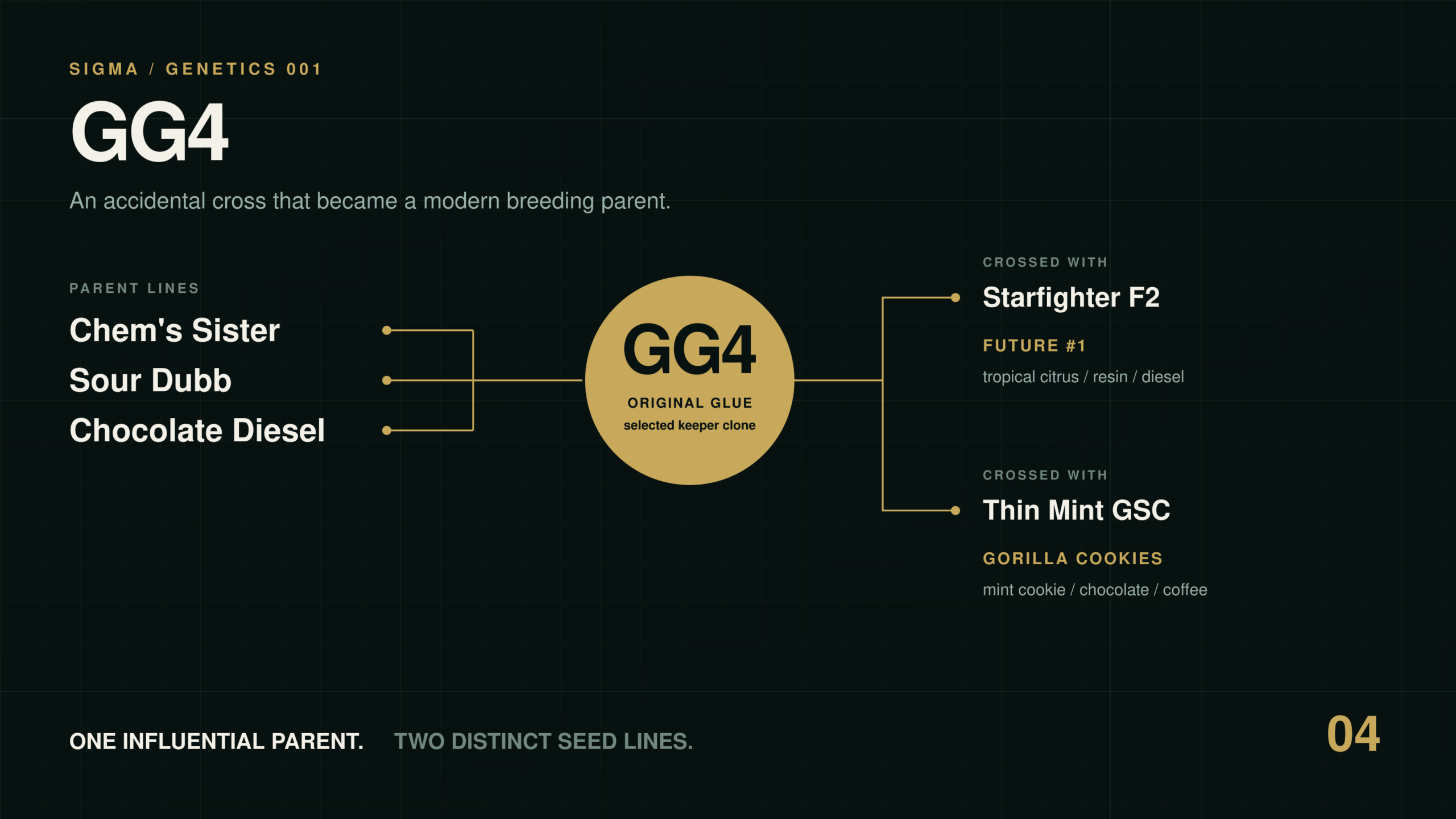
This is not another Gorilla Glue strain review or grow guide. Sigma does not sell an original GG4 reproduction. The reason GG4 belongs in the Sigma library is what breeders built from it. In Future #1, GG4 is crossed with Starfighter F2 to push resin toward tropical citrus. In Gorilla Cookies, it meets Thin Mint GSC and moves toward mint cookie, chocolate and coffee.
Understanding the original parent makes both crosses easier to read. It also opens a good piece of cannabis history: prized clones moving through online grow forums, breeders working under aliases, famous genetics spreading faster than their provenance, and an underground strain name eventually colliding with mainstream trademark law.
In this guide
GG4 Genetics at a Glance
| Common names | GG4 · GG#4 · Original Glue · formerly Gorilla Glue #4 |
| Creators | Joesy Whales and Lone Watty of GG Strains, with Mardogg credited in the selection story |
| Parent lines | Chem’s Sister · Sour Dubb · Chocolate Diesel; exact cross order varies by source |
| Original format | Selected keeper clone |
| Known for | Diesel and earth · chocolate undertone · vigour · branching · unusually heavy resin |
| Breakout period | 2014–2015 competition wins and rapid clone circulation |
Two GG4 Directions in the Sigma Catalogue
| Sigma line | Cross | Direction |
|---|---|---|
| Future #1 | GG4 × Starfighter F2 | Tropical mango, citrus and resin, with diesel underneath |
| Gorilla Cookies | GG4 × Thin Mint GSC | Diesel, mint cookie, dark chocolate, coffee and earth |
These are not alternative names for GG4 and they are not attempts to sell the original clone in seed form. They are distinct seed lines that use GG4 as one parent. The useful question is therefore not “Which one is the real Gorilla Glue?” It is “Which parts of GG4 remain visible after a very different second parent is introduced?”
GG4’s early history comes from breeder accounts, forum records and later interviews. The broad lineage and principal people are well established, but some colourful details vary between retellings. Where the record is uncertain, this guide treats the story as industry lore rather than settled fact.
The Accidental Origin of GG4
The story starts with Don Peabody, better known in cannabis circles as Joesy Whales. After years working as a crane operator, Peabody returned to cultivation and joined the ICMag grow forum under the name Grizz. Online communities like ICMag were important genetic exchanges at the time. Trusted growers moved cuts through private networks, compared selections and documented plants long before a breeder could build an ordinary public-facing brand around them.
Joesy connected with Ross Johnson, known as Lone Watty, and other growers holding sought-after Chem and Diesel material. The event that eventually produced GG4 was not planned. The generally accepted account is that a Chem’s Sister plant produced pollen and seeded Sour Dubb. Joesy was understandably less impressed by the accident than later cannabis history would be. Seeded rooms were a problem, not a product launch.
Accounts differ in their smaller details, including exactly when the Chocolate Diesel step occurred and who retained which seeds. Mardogg is commonly credited with preserving or later germinating material that might otherwise have disappeared. What is consistent is the larger sequence: an accidental Chem’s Sister and Sour Dubb combination was carried forward with Chocolate Diesel, several plants were evaluated, and the fourth labelled selection became the keeper.
Sigma perspective
The useful lesson is not that breeding accidents are secretly better than planned crosses. It is that selection still decides whether an accident becomes a footnote or a cultivar. Many unwanted seeds lead nowhere. GG4 mattered because someone recognised the unusual combination and kept the right plant.
The Lineage: Chem’s Sister × Sour Dubb × Chocolate Diesel
GG4 is consistently associated with Chem’s Sister, Sour Dubb and Chocolate Diesel. The precise cross order is expressed differently across historical accounts, reflecting the informal way the genetics originally circulated. The three parent lines are well established; the bracket placement is less certain.
Chem’s Sister
Chem’s Sister, often shortened to Chem Sis, belongs to the Chemdog family. It contributes the sharp chemical fuel, vigour and unmistakable Chem character running through GG4. The Chem family itself has an origin story built around exchanged flower, found seeds and clone circulation, so GG4 inherited both its aroma direction and some of its culture from that older underground lineage.
Sour Dubb
Sour Dubb, also called Sour Dubble, adds sour fuel, sweetness and resin. Its deeper ancestry is reported less consistently than its role in GG4, which is another reason to avoid presenting every online family tree as laboratory certainty. In the finished GG4 selection, Sour Dubb helps bridge the harsher Chem side and the darker Chocolate Diesel finish.
Chocolate Diesel
Chocolate Diesel brings more diesel weight along with the cocoa, coffee and earthy undertones that distinguish GG4 from a flatter fuel profile. It does not make GG4 smell like a chocolate dessert strain. The chocolate note is darker and dirtier, sitting under the sour chemical top end.
What the parents contribute
| Parent | Direction in GG4 |
|---|---|
| Chem’s Sister | Chemical fuel, vigour and Chem-family intensity |
| Sour Dubb | Sourness, sweetness, resin and aromatic lift |
| Chocolate Diesel | Diesel depth, earth and a dark cocoa or coffee edge |
The Sigma guide to reading cannabis genetics explains why the order of a cross, the selected phenotype and the difference between a seed line and a clone all matter when interpreting names like these.
Why Is It Called GG4?
The number four is a selection label, not a generation. It does not mean F4, BX4 or a fourth attempt at stabilising the line. It identifies the fourth plant in the group being evaluated.
That distinction matters because GG4 was originally a keeper clone. Once number four had been selected, growers could preserve that exact genotype through cuttings. Seeds sold under Glue-style names may descend from the clone, recreate its parent combination or simply use related material, but they should not automatically be treated as the original number-four plant.
This is the same provenance problem found across modern cannabis. A famous clone becomes culturally important; demand outgrows access to verified cuttings; seed versions appear; and the cultivar name gradually starts describing a family of related expressions rather than one genotype. The Sigma breeders guide looks at how responsible breeders work with that problem.
From Forum Cut to Competition Phenomenon
GG4’s rise was fast because the plant was visually difficult to ignore. Resin coverage gave it the adhesive identity, while the Chem-Diesel aroma made it recognisable before the name had become universal. The clone circulated through trusted grower networks and then broke into the wider market through competition success.
GG4 collected prominent competition recognition from 2014 onward, including a first-place result at the 2014 High Times Los Angeles Cannabis Cup. Event names, categories and dates are not reported consistently across surviving competition records, but the broader result is clear: GG4 accumulated enough recognition in a short period to move from insider clone to international reference point.
Timing helped. Legal cannabis markets were expanding, social media was accelerating strain recognition, and growers were hungry for highly photogenic resin cultivars. GG4 arrived with a strong story, an unforgettable name and a plant that looked made for the new visual culture of cannabis.
It also spread during a period when provenance could be difficult to control. Verified cuts, mislabelled cuts and unrelated “Glue” products all circulated at once. By the time GG Strains tried to formalise licensing and protect the original material, the name had already escaped into common use.
Why Gorilla Glue Became GG4 and Original Glue
The original name referred to the cultivar’s extreme stickiness. One frequently repeated version says the resin caused a telephone receiver to stick to Joesy’s hand. Other versions focus on scissors and fingers becoming glued together during trimming. The exact prop changes, but the reason for the name does not: the plant produced conspicuously adhesive resin.
There was one obvious problem. Gorilla Glue was already a well-known adhesive trademark.
In 2017, the Gorilla Glue Company brought a trademark case against GG Strains. The dispute ended in a settlement requiring the cannabis company and its partners to phase out the Gorilla Glue wording and gorilla imagery. The associated domain was also surrendered. Gorilla Glue #4 became Original Glue, while GG4 and GG#4 remained the practical names used throughout cannabis culture.
The case is a useful piece of industry history. Underground strain naming had traditionally rewarded jokes, references and borrowed cultural material. Commercial legal markets brought those names into contact with ordinary intellectual-property law. GG4 became one of the clearest early examples of a famous cultivar having enough commercial value to attract a trademark owner outside cannabis.
A name that would not leave
The settlement changed the official branding but could not remove the old name from grow-room vocabulary. Today GG4, GG#4, Original Glue and Gorilla Glue #4 are still used for the same historic selection. For clear provenance, Sigma uses GG4 when discussing the parent and records the older name only where it helps identify the lineage.
What GG4 Contributes to Modern Breeding
GG4 became a major parent because its traits are both desirable and legible. Breeders can usually see what the Glue side is doing in a cross.
Resin production is the headline contribution. GG4 can push conspicuous trichome coverage and gives breeders a strong starting population for selecting extraction-oriented plants. It is not a guarantee that every descendant will wash well. Visible frost does not measure trichome-head release or return, but it makes GG4 a logical parent when resin is part of the breeding objective.
Vigour and branching are equally important. GG4 tends to build a productive frame with strong lateral growth, although individual descendants can stretch considerably. Crossed with denser Cookies-family plants, that open vigour can help loosen structure while the Cookies side brings compactness back into the flowers.
Diesel identity gives the offspring an aromatic backbone. GG4 rarely disappears politely into a cross. Its fuel, earth and sour chemical note can remain obvious even when the other parent supplies fruit, mint, cookie dough or tropical character.
Variation is the trade-off. A GG4 hybrid can split between tall diesel-heavy plants, compact expressions closer to the other parent and more integrated keepers between them. That makes the line attractive for selection, but less useful to anyone expecting every seed to reproduce a single clone. The phenohunting guide explains how to assess that variation rather than treating it as a defect.
GG4 Genetics in the Sigma Catalogue
GG4 appears in Sigma through two very different breeding directions.
Future #1: GG4 × Starfighter F2
Future #1 crosses GG4 with Starfighter F2. The Glue side supplies resin, diesel depth and structural vigour; Starfighter shifts the profile toward tropical fruit and citrus. It is a useful example of GG4 being used to carry resin and force into a brighter aromatic direction. The Future #1 strain guide examines the lineage and the much-repeated 37% THC claim in detail.
Gorilla Cookies: GG4 × Thin Mint GSC
Gorilla Cookies takes GG4 into the Cookies family through Thin Mint GSC. This combination retains the fuel and resin while adding mint cookie, chocolate, coffee and a more compact structural option. The selection challenge is finding a plant that holds both identities rather than collapsing into generic sweetness or straight diesel.
For the wider Cookies side of that story, the Cookies cannabis lineage guide traces GSC through Gelato, Sunset Sherbet, Jealousy and later hybrids.
Why GG4 still matters
GG4 is not important because every modern cross needs more frost or a famous name. It matters because the original selection joined resin, vigour and a distinctive diesel-chocolate profile in a plant breeders could use. More than a decade later, its influence remains easy to recognise in the right offspring.
Frequently Asked Questions About GG4 Genetics
Why is GG4 important to modern cannabis breeding?
GG4 combines heavy resin production, vigorous branching and a recognisable diesel, earth and dark-chocolate profile. Those traits remain legible in many descendants, making the clone useful as a parent rather than merely famous as a strain.
What genetics make up GG4?
Chem’s Sister, Sour Dubb and Chocolate Diesel are the three parent lines consistently associated with GG4. Historical sources differ on the precise cross order, so the parent set is more certain than the bracket placement.
Are GG4 and Original Glue the same cultivar?
Yes. Original Glue is the official replacement name for the cultivar formerly called Gorilla Glue #4. GG4 and GG#4 remain the common shorthand used by growers and breeders.
What does GG4 contribute to Future #1?
In Future #1, GG4 contributes resin, vigour and diesel depth. Starfighter F2 moves the cross toward tropical mango, pineapple and citrus, creating a brighter expression than the original GG4 profile.
What does GG4 contribute to Gorilla Cookies?
In Gorilla Cookies, GG4 supplies fuel, branching and resin. Thin Mint GSC adds mint cookie, chocolate, coffee and a denser Cookies-family structural direction.
Are GG4 descendants the same as the original clone?
No. The original GG4 is one selected genotype preserved through cuttings. Future #1 and Gorilla Cookies are separate seed lines that inherit part of GG4 while recombining it with a different second parent.
Seeds contain no THC or CBD. This material is provided for genetic, historical and educational reference only and is not medical or legal advice. Always check the laws that apply in your location before germinating or cultivating cannabis seeds.
